

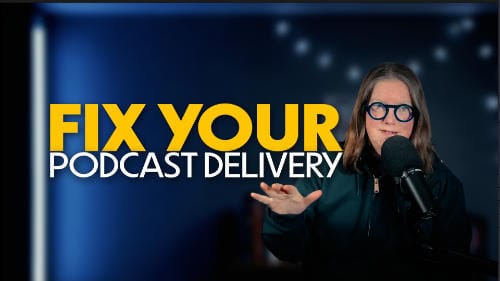

You have finished writing your script. You sit down, hit record, and suddenly your voice goes flat. You sound like you are reading a textbook rather than having a conversation. This is a friction point for almost every solo podcaster. You want to sound authoritative and expert, but reading word-for-word often strips away the humanity that connects you to your audience.
The solution lies in how you interact with your text. There are four distinct methods you can use to deliver a script, ranging from full memorization to improvisation. Let’s answer some of the most common questions people have.
What is the best way to read a script naturally?
The best way to read a script naturally is to use the “Reference Cue” method combined with slight improvisation. This involves formatting your script with bold keywords or “anchor words” rather than reading full sentences. You glance at the bolded phrase to trigger the concept in your memory, look at the camera, and deliver the thought in your own words. This technique leverages your brain’s natural ability to fill in gaps, ensuring you maintain eye contact and vocal variety while staying on message.
How does reading style affect podcast editing time?
Your delivery method directly correlates to your post-production workload. There is a distinct trade-off: the more you rely on reading verbatim, the less editing you might need for content errors, but you risk a robotic performance. Improvising off bullet points creates a very natural sound but often results in more “ums,” “ahs,” and rambling that often needs to be cut later. You must decide if you want to spend your energy on performance (cognitive load during recording) or on editing (time spent cleaning up after).
What is the “Look Down, Look Up” style of delivery?
The “Look Down, Look Up” method is a technique where you read a sentence from your script, memorize it briefly, look up at the camera lens, and deliver the line from memory. You then look back down… and repeat the process. This ensures you never appear to be reading on camera. However, it is extremely time-consuming and breaks the natural flow of a long narrative. This method is best reserved for short-form content like YouTube Shorts, TikTok, or Instagram Reels where jump cuts are acceptable. So you might want to save this one for marketing your podcast instead.
How do you use a teleprompter without looking like you are reading?
To use a teleprompter effectively, you must practice “scan reading.” This means your eyes are scanning one or two words ahead of what your mouth is speaking. You are processing the upcoming phrase while delivering the current one. It requires practice to maintain energy and vocal inflection because your brain is splitting its focus between processing text and performing. Adjusting the text size and scroll speed is critical to minimizing obvious eye movement if you’re delivering your podcast to video.
But if you’re only delivering your podcast to audio, then all you need to do is rehearse this way of reading to make it sound like you’re not reading at all. No teleprompter or worrying about your eye movements necessary.
What are memory anchors in public speaking?
Memory anchors, or retrieval cues, are specific words or phrases that trigger the recall of a larger concept. In podcasting, you can bold a single word in your notes (ie, “Efficiency“) to remind you to speak about a specific paragraph you wrote. Your brain recognizes the cue and fills in the rest of the information (the “gist”) automatically. Relying on anchors allows you to speak naturally because you are formulating sentences in real-time rather than decoding written text.
Author: Jen deHaan is the host of the Podcast Performance Lab and founder of StereoForest Studio, a professional podcast production house helping experts build authority through audio and video.
Watch or Listen
You can listen to or watch the full breakdown in the full episode on the Solo Podcasting Handbook.


[…] The solution is a workflow rooted in “extemporaneous speaking.” This method uses a rigid structure combined with bullet points to guide the host while allowing for natural, in-the-moment delivery. […]